What Is Vacuum Casting?
If you are wondering which is the most economical way to make more prototypes? Then you should try vacuum casting. Vacuum casting is a widely used process in rapid prototyping, typically used for building 10 to 50 pieces of functional prototypes out of broad range of polyurethanes and other polymers. We can accurately reproduce the prototypes with original color, over-mold, texture and geometries from the mater model and components.
How Does Vacuum Casting Work?
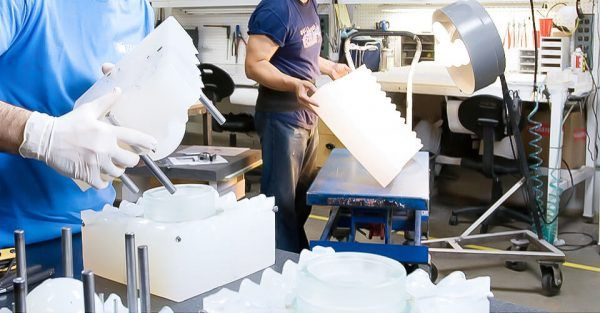
Vacuum casting is a copying technique used for the production of small series of functional plastic parts. Using two-component polyurethanes and silicone molds, vacuum casting is known for its fast production of high-quality prototypes or end-use products.
One silicone mold can cast about 15-20 pieces of parts, depends on complexity, painting or original color, size and other factors in different parts. The typical lead time is 5-7 working days for 10 parts.
Technical Specification
| Standard Accuracy | ±0.3% (with a lower limit on ± 0.3 mm on dimensions smaller than 100 mm). Generally, a shrinkage rate of 0.15% is to be expected. |
| Minimum wall thickness | To ensure that the mold is filled properly, a wall thickness of at least 0.75 mm is necessary. For best results, we recommend a wall thickness of at least 1.5 mm |
| Maximum part dimensions | The size of the mold is limited by the dimensions of the vacuum chamber (1900 x 1500 x 1200 mm) and by the volume of the product (maximum volume: 10 liters) |
| Standard lead time | Up to 10 copies within 15 working days |
| Typical quantities | Up to 25 copies per mold (depending on the mold’s complexity and the casting materials) |
| Surface structure | High-quality surface finish comparable to injection molding |